Does motor current contain task-relevant information?
This requires the registers to be available at the policy rate and to exhibit repeatable variation under contact-relevant conditions beyond their quiet-state variation.
Can weak, uncalibrated motor-current signals already available on a low-cost robot provide a useful learned contact representation for contact-rich visuomotor imitation learning?
In free space, a camera shows where an object is and joint positions show the position of the arm in space. Contact-rich manipulation is harder because the state that matters may be physical, and no longer geometric. A gripper closes without securing an object. A peg reaches the hole and presses against its rim. Two nearly identical camera images precede a smooth insertion in one case and a jam in the other.
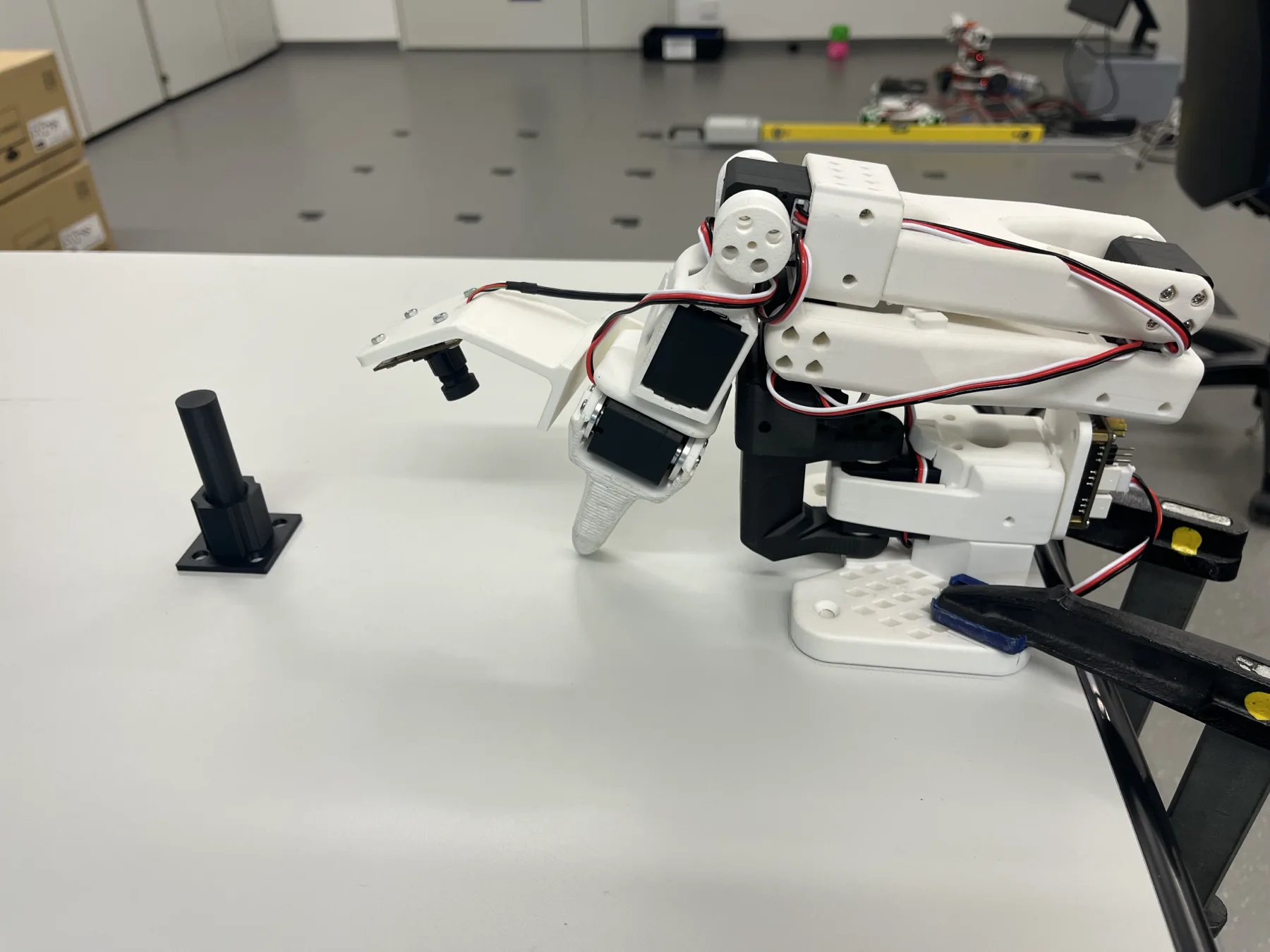
The SO-101 used in this study is fitted with Waveshare ST3215 servos. Their control table specifies a read-only motor-current register. Reading that register adds no sensor and no mechanical modification to the arm.
This loss of direct visual evidence near contact is a central observability problem in contact-rich imitation learning.
Images and joint positions provide strong information about appearance, configuration, and motion. They do not directly measure interaction effort.
Contact-aware policies add tactile, force, or torque measurements to vision and kinematics. These measurements reveal contact onset, load, deformation, or slip, and they usually require added hardware, calibration, or a robot that already gives reliable torque estimates.
The SO-101 used in this study is fitted with Waveshare ST3215 servos, whose control table specifies a read-only motor-current register. Reading that existing register adds no sensor or mechanical modification to the study arm.
Motor-side current is affected by pose, motion, friction, and the high-ratio transmission. It does not specify the direction or location of an external force.
Three questions make the investigation operational. The three claims are kept apart because they are easy to confuse. The signal may contain task-relevant information. A trained model may use that information. Using it may improve closed-loop behaviour.
This requires the registers to be available at the policy rate and to exhibit repeatable variation under contact-relevant conditions beyond their quiet-state variation.
This asks whether changing the current input while holding image and position fixed changes the actions predicted by a trained policy.
This compares policies with and without current during repeated physical peg-in-hole trials and examines where failures occur.
The investigation covers one low-cost manipulator, one primary peg-in-hole task, one demonstration dataset, and the evaluated ACT and Diffusion Policy implementations.
Before motor current can be added to a policy, it must first be shown to carry a repeatable and task-relevant signal.
Empty closes reach a maximum of 27.3 ± 0.9 counts. Closes in the first pen block, second pen block, and towel block reach 91.5 ± 27.6, 89.1 ± 25.5, and 96.1 ± 7.4 counts, respectively. The corresponding differences from the empty-close condition are d = 3.29, 3.42, and 13.06. The especially large value for the towel condition comes mainly from its lower dispersion and should not be interpreted as evidence for a general material classifier.
The clearest recurring changes occur at the shoulder lift and elbow. The remaining joints have median excursions between 1.50 and 4.00 counts. The initial boundary candidates came from a current-based heuristic, so this review was not blind to the current signal.
On this arm and task, the ST3215 register distinguishes contact-relevant conditions, so motor current is suitable for evaluation as an additional policy input. The signal is also pose-dependent, zero-inflated in the training data, and integer-quantised. It is neither a calibrated force measurement nor a directional contact measurement.
A fair comparison between a vision-based policy and a current-aware policy requires more than recording both modalities. The policies must learn from the same demonstrations, images, joint positions, and action targets, while the additional current input is introduced through a reproducible transformation.
Phase annotations are stored separately and are never policy inputs. The annotation table contains 32 episodes reviewed against video. One row records its phase boundaries out of order and is excluded.
Demonstrations were recorded with the LeRobot leader-follower interface and two mechanically similar SO-101 arms. The primary dataset combines two 50-episode vertical-insertion batches recorded with the same task and schema. Each source batch contains two collection sessions of 25 episodes, giving four sessions in total.
Across the six channels, 44.9% of the values are zero, and the per-joint zero fractions range from 34.6 to 54.0%. The selected representation caps each joint independently at the 99.5th percentile of its training distribution. The fitted caps are 4, 33, 32, 8, 3, and 33 counts for shoulder pan, shoulder lift, elbow flexion, wrist flexion, wrist roll, and gripper, respectively.
Using motor current as a policy observation requires a representation that preserves useful variation and combines it effectively with vision and joint position.
| Comparison | Vision and position | Current aware |
|---|---|---|
| Raw direct ACT | ACT-V | The first comparison appends the six raw current values to the six joint positions. |
| Normalised direct ACT | ACT-V | The revised input clips each current channel at its training-set 99.5th percentile and then applies the saved normalisation transform. |
| Joint-selective temporal ACT | ACT-V | The joint-selective temporal comparison replaces instantaneous concatenation with six current histories, a shared temporal convolution, and one token per joint. |
| Residual-conditioned Diffusion Policy | DP-V | The selected model uses joint-selective temporal encoding and bounded residual conditioning. DP-V updates its base network, while DP-M freezes the copied base and trains the added current route. |
Every principal policy uses feature subsets of the same 100-demonstration vertical peg-in-hole dataset. The ACT pairs share the dataset, seed, model family, and rollout controller within each comparison. The final Diffusion pair differs in base-network trainability as well as current conditioning, which limits its causal interpretation.
The principal comparisons use interleaved blocks to expose both policies to similar conditions within a session. A 30-trial comparison contains five blocks, each with six trials per policy. The timeout is 45 s. An absolute difference of 10 percentage points was fixed before the normalised comparisons as the smallest change considered practically relevant.
Binary task success is the primary endpoint. A trial succeeds when the peg is fully seated and flush with the fixture surface before the timeout. Every other outcome is a failure. One operator resets and scores every trial.
The vision-and-position control.
Under the evaluated data, preprocessing, fusion, and execution settings, adding current does not produce a reliable improvement in closed-loop insertion success.
Success proportions are reported with Wilson 95% confidence intervals. A trial succeeds when the peg is fully seated and flush with the fixture surface before the timeout. Every other outcome is a failure.
Raw and normalised direct concatenation do not improve ACT success. The raw system performs substantially worse in its fixed-order session. The two normalised sessions keep the same negative direction without resolving a difference. The point estimates for both learned current routes favour the current-aware policy. Their confidence intervals are too wide to establish statistically supported superiority.
| Comparison | Without current | Successes | With current | Successes | Test |
|---|---|---|---|---|---|
| Raw direct ACT | ACT-V | 19/30 (63.3%) [45.5, 78.1] | Direct ACT-M | 8/30 (26.7%) [14.2, 44.4] | Fisher p = 0.0089 |
| Normalised direct ACT, two sessions | ACT-V | 27/50 (54.0%) [40.4, 67.0] | ACT-M-norm | 21/50 (42.0%) [29.4, 55.8] | session-stratified CMH p = 0.318 |
| Joint-selective temporal ACT | ACT-V | 7/30 (23.3%) [11.8, 40.9] | Joint-selective ACT-M | 12/30 (40.0%) [24.6, 57.7] | Fisher p = 0.267 |
| Residual-conditioned Diffusion Policy | DP-V | 9/30 (30.0%) [16.7, 47.9] | DP-M | 12/30 (40.0%) [24.6, 57.7] | Fisher p = 0.589 |
The point in each row is the observed current-aware success rate minus the corresponding vision-and-position baseline rate, and the horizontal line is its Newcombe–Wilson 95% interval.
The raw direct ACT interval is the only principal interval that excludes zero, and it points towards harm. It is also the only principal session in which ACT-V always ran before ACT-M within a block. The pooled normalised rates are descriptive only, because the sessions occurred on different days.
The unchanged ACT-V checkpoint varies significantly across sessions, and both Diffusion Policy arms deteriorate together across blocks. These patterns show why a contemporaneous control is essential and why absolute success counts from separate days cannot be used to rank current representations. Current is informative at the sensor level and can influence predicted actions, but the tested policies do not convert that information into a repeatable behavioural advantage.
The mean-imputation diagnostic evaluates each current-aware checkpoint twice on the same observation. One pass uses the recorded current, while the other replaces current with its training-set mean. Images and joint positions are left unchanged.
These interventions are not physically equivalent and do not rank the intrinsic value of the modalities. They do show that both checkpoints react less strongly to current than to the tested position and image changes. No checkpoint-specific diagnostic survives for the principal joint-selective temporal ACT-M policy, so none is inferred from a different checkpoint.
The diagnostic establishes that current reaches the action output in the two retained principal checkpoints for which the test is available. It does not show whether the induced action change is useful. That question requires the closed-loop comparisons.
The evidence supports a clear distinction between the information available in the motor-current signal and the control benefit achieved by the evaluated policies.
Controlled gripper experiments show strong separation between object-present closes and misses, while the insertion analysis identifies task-aligned variation across several arm joints. On the evaluated platform, current is an informative effort signal.
Counterfactual mean imputation shows measurable action changes in the retained normalised direct ACT and learned-current Diffusion checkpoints. These interventions establish checkpoint sensitivity to current, not a task-performance benefit.
A closed-loop improvement is not demonstrated by either ACT or Diffusion Policy under the evaluated data, fusion, and execution conditions.
The experiments keep apart three claims that are often treated as one. The signal contains relevant information. A model responds to it. The response improves closed-loop behaviour. The first two hold on this platform. The third does not.
The resulting claims are specific to the evaluated task, operator, training runs, servo family, and robot embodiment.
@mastersthesis{ranpariya2026contact,
  author = {Jaydeepkumar Ranpariya},
  title  = {Learning Contact Representations from Zero-Cost
            Proprioceptive Effort Signals for Contact-Rich
            Visuomotor Imitation Learning},
  school = {Friedrich-Alexander-Universit{\"a}t Erlangen-N{\"u}rnberg},
  year   = {2026},
  note   = {In cooperation with Fraunhofer IIS},
  url    = {https://contact-from-current.pages.dev/}
}